ch1.intro
Ch 1. Introduction
Deep Learning
-
Deep Learning Fundamentals:
- Unlike traditional programming with predefined rules, deep learning learns patterns from examples.
- Intelligence is often conflated with self-awareness, but self-awareness is not necessary for AI to perform complex tasks.
- Edsger W. Dijkstra compared the debate over machine intelligence to asking whether submarines can swim. 0
- Deep learning trains deep neural networks using large datasets to approximate complex functions.
-
The Deep Learning Revolution:
- Traditional machine learning relied on feature engineering, where human-defined transformations made data more suitable for algorithms.
- Example: Identifying handwritten digits by defining edge filters and counting enclosed loops.
- Deep learning automates feature extraction from raw data, refining its own representations during training.
- Handcrafted features are still useful but are often outperformed by deep learning’s automated feature learning.
- Traditional machine learning relied on feature engineering, where human-defined transformations made data more suitable for algorithms.
-
Comparison of Traditional ML vs. Deep Learning:
- Traditional ML: Features are manually designed, and results depend on their quality.
- Deep Learning: The model extracts hierarchical features autonomously, optimizing its own performance.
-
Requirements for Deep Learning Success:
- Ability to ingest and process data.
- Definition of a deep learning model.
- Training process to learn useful representations and achieve desired outputs.
-
Training Process in Deep Learning:
- A criterion function evaluates the discrepancy between model predictions and actual data.
- Training iteratively adjusts the model to minimize this discrepancy.
- The goal is to achieve low error rates, even on new, unseen data.
PyTorch for Deep Learning
-
Overview:
- PyTorch is a Python library designed for deep learning, offering flexibility and a user-friendly syntax.
- Initially popular in research, it has grown into a widely used deep learning tool across various applications.
- Its Pythonic nature makes it approachable for beginners while remaining powerful for professionals.
-
Key Features of PyTorch:
- Provides Tensors, a core data structure similar to NumPy arrays, enabling mathematical operations.
- Supports GPU acceleration, significantly speeding up computations compared to CPUs.
- Includes optimization tools for deep learning, making model training more efficient.
- Designed for expressivity, allowing complex models to be implemented with minimal complexity.
- Well-suited for scientific computing, beyond just deep learning applications.
Overview of How PyTorch Supports Deep Learning Projects
Core Structure of PyTorch
- Primarily a Python library, but much of its underlying code is written in C++ and CUDA for performance.
- Supports C++ execution for deploying models in production environments.
- The Python API is the main interface for model development, training, and inference.
Key PyTorch Components
- Tensors (
torch.Tensor)- Multi-dimensional arrays similar to NumPy arrays.
- Can run on both CPU and GPU, with easy switching.
- Autograd (
torch.autograd)- Enables automatic differentiation for training deep learning models.
- Tracks operations on tensors and computes derivatives for optimization.
- Neural Network Module (
torch.nn)- Contains building blocks for deep learning models (e.g., layers, activation functions, loss functions).
- Optimizers (
torch.optim)- Provides optimization algorithms (e.g., SGD, Adam) to train models.
- Data Handling (
torch.utils.data)Datasetclass: Converts raw data into PyTorch-compatible tensors.DataLoaderclass: Loads and batches data efficiently, supporting parallel processing.
Deep Learning Workflow in PyTorch
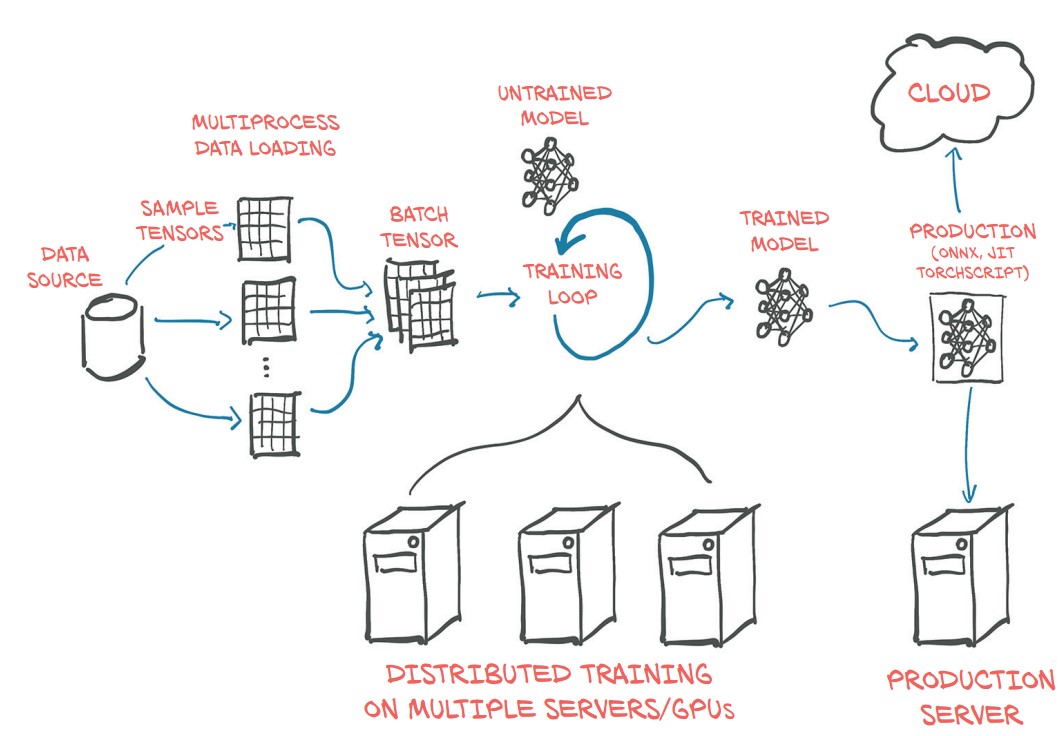
- Data Preparation
- Data is loaded from storage and converted into tensors.
DatasetandDataLoaderhandle data transformation and batching.
- Model Definition
- Built using
torch.nncomponents like fully connected layers and convolutions.
- Built using
- Training Process
- A training loop iterates over the dataset using
forloops. - Loss functions from
torch.nncompare predictions with targets. - Autograd computes gradients automatically.
- Optimizers from
torch.optimadjust model parameters. - Can be scaled to multi-GPU or distributed computing using
torch.nn.parallel.DistributedDataParallel.
- A training loop iterates over the dataset using
- Deployment
- The trained model can be exported and used in different environments.
- Deployment options include:
- Running the model on a server or cloud platform.
- Embedding the model in a larger application or mobile device.
- Exporting with ONNX for compatibility with different runtimes.
- TorchScript compilation for optimized execution outside Python.
Production Capabilities
- Eager Execution (default): PyTorch operations execute immediately in Python.
- TorchScript: Allows ahead-of-time compilation, enabling model execution in C++ or mobile environments.
- ONNX Support: Exports models for interoperability with different AI frameworks.